Byron's Bible
On Lucifer and Exegesis

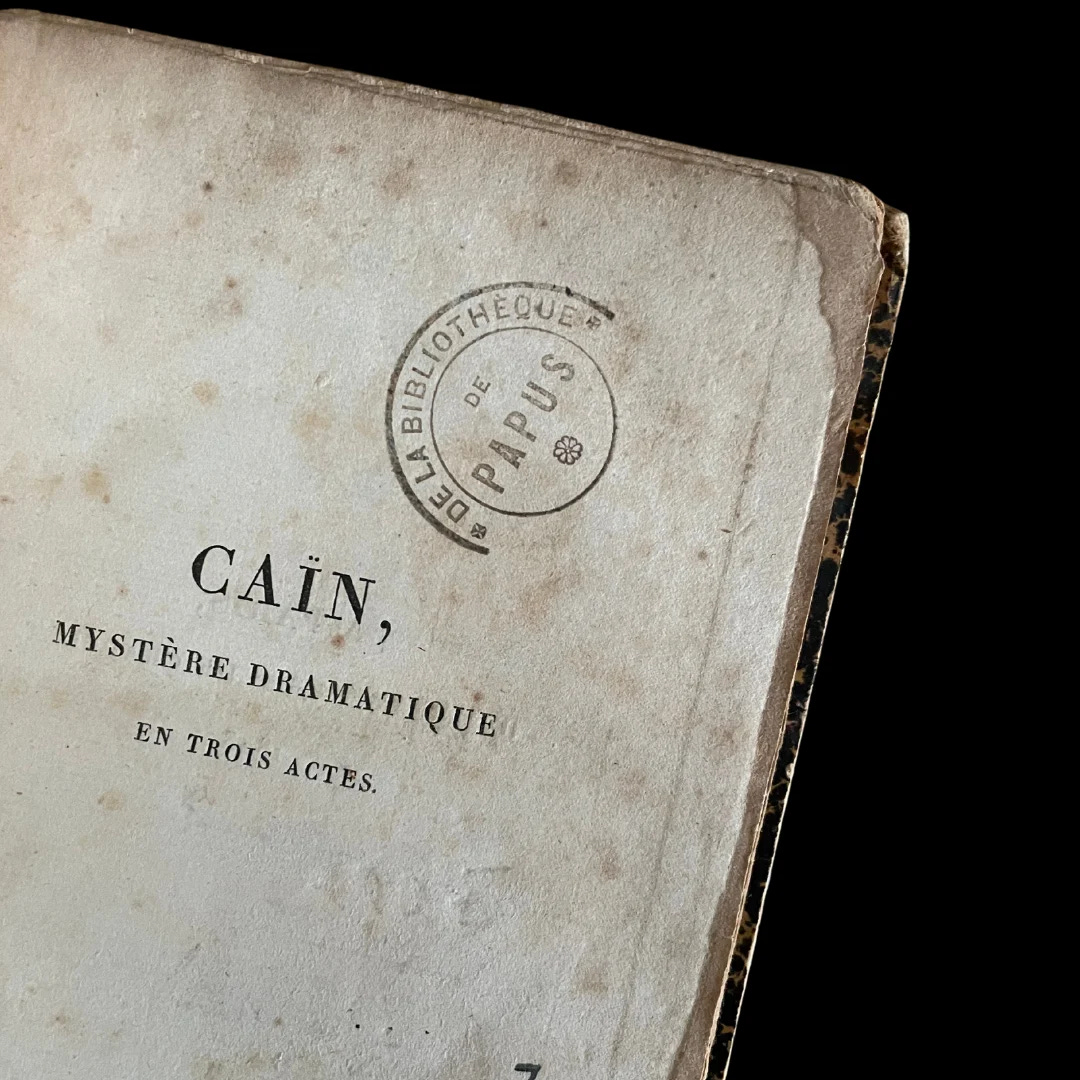
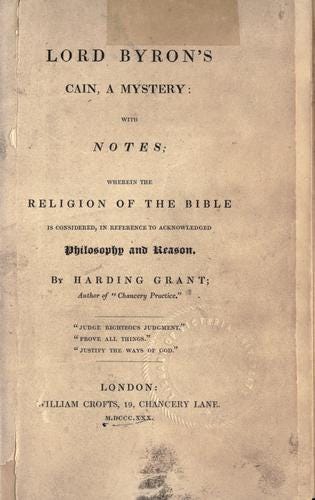
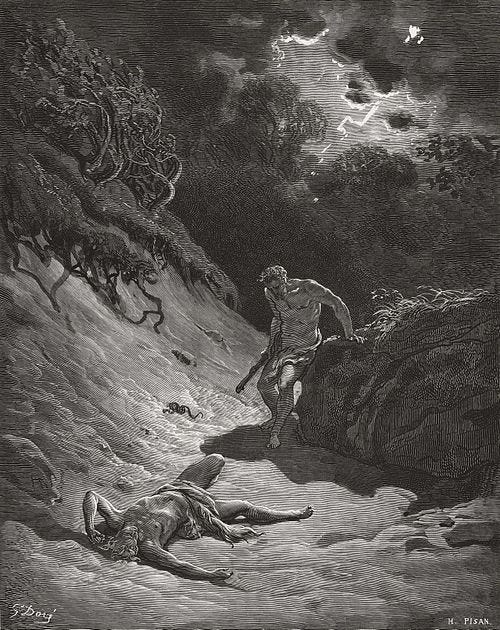
In honor of Lord Byron’s 238th birthday (Jan. 22, 1788), Romanticon has published my piece on his closet drama Cain: A Mystery. It is a work I first stumbled across in my high school years and its exegetical and imaginative interrogations of Genesis have never left me since.
This is my second piece for Romanticon (the first being an essay on Diotima and Romantic Platonism) and they have been a delight to work with both times. The Romantics didn’t leave any subject off the table and Romanticon seems committed to exploring this expanded sense, scope, and ambition of Romanticism as a project. On the other side of things, talking about biblical exegesis and moral criticism can be a difficult task in popular religious outlets, and I’m grateful for the chance to be able to publish my thoughts in full on Byron and the questions he raises. These are not literary or historical curiosities for me, understanding how to read (and not to read) the Bible is a central part of my spiritual life. Reading the Bible can ruin you. It can kill you (2 Cor. 3:6).
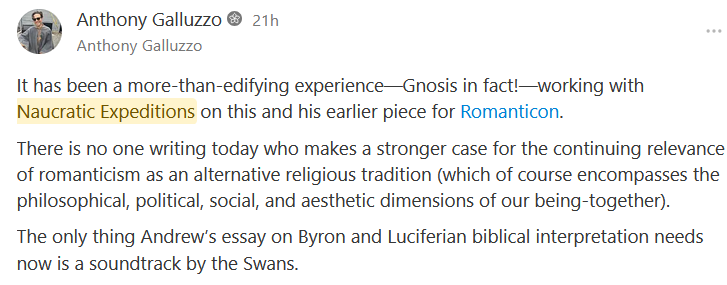
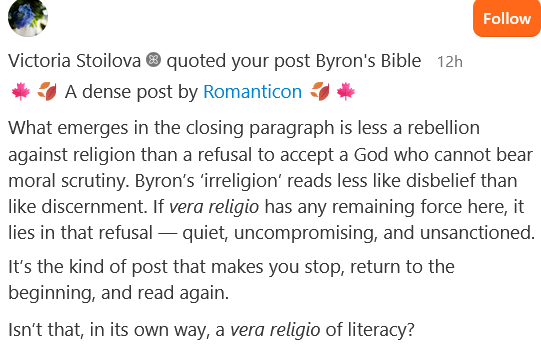
And, as a teaser and attempt to scare up more readers, I’ll share some of the (hyperbolic) praise the piece has received from the editors and elsewhere. Apparently the reception ranges from “gnosis” to “pretty metal”.

Most importantly, today go read Byron and go read your Bible.
Just read it and it is very very good. I don’t think it’s quite right to call the work “anti-Milton” though, but I get what you meant. I think this sympathetic reading of the great Romantics is much needed and very fruitful. I don’t like the very unnecessary and ultimately barren dialectic of Cyril O’Regan’s “Catholic” anti-Romantic stance, and Harold Bloom’s “Gnostic” anti-Catholic stance, since both obscure just how radical Christianity really is, and set up theological dead-ends.
The great George Macdonald was wiser than most theologians in his judgment of Shelley: “As regards his religious opinions, one of the thoughts which most strongly suggest themselves is,—how ill he must have been instructed in the principles of Christianity! He says himself in a letter to Godwin, “I have known no tutor or adviser (not excepting my father) from whose lessons and suggestions I have not recoiled with disgust.” So far is he from being an opponent of Christianity properly so called, that one can hardly help feeling what a Christian he would have been, could he but have seen Christianity in any other way than through the traditional and practical misrepresentations of it which surrounded him. All his attacks on Christianity are, in reality, directed against evils to which the true doctrines of Christianity are more opposed than those of Shelley could possibly be. How far he was excusable in giving the name of Christianity to what he might have seen to be only a miserable perversion of it, is another question, and one which hardly admits of discussion here. It was in the name of Christianity, however, that the worst injuries of which he had to complain were inflicted upon him. Coming out of the cathedral at Pisa one day, [Footnote: From Shelley Memorials, edited by Lady Shelley, which the writer of this paper has principally followed in regard to the external facts of Shelley’s history.] Shelley warmly assented to a remark of Leigh Hunt, “that a divine religion might be found out, if charity were really made the principle of it instead of faith.” Surely the founders of Christianity, even when they magnified faith, intended thereby a spiritual condition, of which the central principle is coincident with charity. Shelley’s own feelings towards others, as judged from his poetry, seem to be tinctured with the very essence of Christianity. [Footnote: His Essay on Christianity is full of noble views, some of which are held at the present day by some of the most earnest believers. At what time of his life it was written we are not informed; but it seems such as would insure his acceptance with any company of intelligent and devout Unitarians.] He did not, at one time at least, believe that we could know the source of our being; and seemed to take it as a self-evident truth, that the Creator could not be like the creature. But it is unjust to fix upon any utterance of opinion, and regard it as the religion of a man who died in his thirtieth year, and whose habits of thinking were such, that his opinions must have been in a state of constant change.” (A Dish of Orts)